
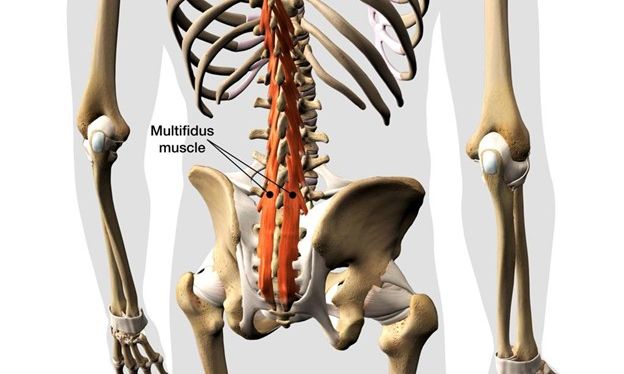
Multifidus Dysfunction: A Hidden Driver of Chronic Low Back Pain
What Is the Multifidus Muscle?
The multifidus is a deep spinal stabilizing muscle system that attaches from one vertebra to the next along the entire spine. Unlike larger “movement” muscles, the multifidus is a segmental stabilizer, meaning it controls small, precise motions between individual vertebrae.
Its primary responsibilities include:
• Maintaining spinal alignment • Controlling micro-movements between vertebrae • Protecting discs and facet joints from excessive stress • Supporting upright posture • Providing automatic stability during bending, lifting, and twisting
In a healthy spine, the multifidus activates before movement begins, creating a stable base that allows the body to move safely and efficiently.
What Is Multifidus Dysfunction?
Multifidus dysfunction occurs when this deep stabilizing system becomes inhibited, weak, or atrophied. This commonly happens after:
• Acute low back injury • Disc herniation or degeneration • Recurrent episodes of back pain • Spinal surgery • Prolonged inactivity
Research shows that spinal injury can cause the multifidus to shut down through a neurological reflex called Arthrogenic Muscle Inhibition which is a reflexive neurological response in which injury, inflammation, or irritation of a joint causes the nervous system to reduce activation of muscles that stabilize that joint.
In the spine, when structures such as discs, facet joints, ligaments, or joint capsules are injured, sensory receptors send abnormal signals to the central nervous system. These signals trigger a protective reflex that reduces motor neuron activity to nearby stabilizing muscles, including the multifidus.
The result is decreased muscle activation even when the person attempts to contract the muscle voluntarily.
Even after pain improves, the muscle often does not automatically recover.
How the Reflex Works
The mechanism involves altered sensory input from several joint receptors, including:
• Mechanoreceptors in the facet joints and ligaments • Nociceptors activated by pain or inflammation • Joint capsule receptors
These receptors send signals through spinal sensory pathways to the spinal cord and brainstem. The central nervous system interprets this input as a threat to the joint and responds by inhibiting the alpha motor neurons that drive stabilizing muscles.
This process occurs at both the spinal cord level and supraspinal centers.
Why the Multifidus Is Especially Affected
The multifidus is particularly vulnerable to this inhibition because it functions as a segmental stabilizer that responds to subtle changes in joint position and loading.
Studies have shown that after a lumbar injury:
• Multifidus activity can decrease within days • Muscle cross-sectional area begins to shrink rapidly • Atrophy may occur on the side of injury • Fatty infiltration may develop if inhibition persists
Importantly, this inhibition does not automatically resolve when pain improves.
Why This Matters Clinically
Because the multifidus remains neurologically inhibited:
• The spine loses segmental control • Larger global muscles compensate • Mechanical stress increases on discs and joints • Recurrent episodes of back pain become more likely
The spine may still move, but it loses its internal support system. This explains why many patients improve temporarily but experience repeated flare-ups.
Over time, this leads to:
• Muscle atrophy • Fatty infiltration replacing healthy muscle tissue • Delayed activation timing of spinal stabilization • Loss of segmental spinal control
The spine may still move, but it loses its internal support system.
Why Multifidus Dysfunction Matters
Segmental Instability
Without deep stabilization, individual spinal segments move excessively. Larger muscles attempt to compensate, but they are designed for gross movement, not fine motor control.
Increased Disc and Joint Stress
Excessive micro-movement increases shear forces on spinal discs and facet joints, accelerating degeneration and inflammation.
Recurrent Pain Cycles
Instability leads to irritation → inflammation → protective muscle guarding → further inhibition of stabilizers → worsening instability.
False Appearance of Strength
Patients may appear strong but lack deep stabilizer function. Traditional exercise programs often strengthen superficial muscles while the underlying problem persists.
Imaging Findings in Chronic Back Pain
Advanced imaging frequently shows:
• Multifidus muscle wasting • Side-to-side asymmetry • Fatty replacement of muscle tissue • Persistent atrophy even after symptoms improve
This explains why many individuals:
• Improve temporarily with passive care • Feel better with general exercise • Experience relapse when returning to normal activity
Because the stabilizing system remains compromised.
Pelvic Stabilization Is Essential for Multifidus Activation
One of the most overlooked aspects of spinal rehabilitation is pelvic control.
If the pelvis is not stabilized during exercise:
• Larger hip and trunk muscles compensate • Spinal motion occurs without segmental control • The multifidus remains under-recruited • Strengthening becomes inefficient and misleading
Because the pelvis serves as the mechanical foundation of the lumbar spine, uncontrolled pelvic movement allows patients to “cheat” exercises using global musculature.
Proper pelvic stabilization:
• Locks the hips in place • Eliminates momentum and substitution • Forces deep spinal muscles to engage • Allows true isolation of lumbar stabilizers • Restores accurate neuromuscular control
Without pelvic stabilization, it is nearly impossible to specifically target the multifidus.
Why Standard Core Exercises Often Fail
Common programs emphasize:
• Planks • Crunches • Sit-ups • General strengthening routines
These exercises mainly recruit large superficial muscles, including:
• Rectus abdominis • Obliques • Erector spinae • Hip flexors
While beneficial for general fitness, they do not effectively restore deep segmental stabilizers.
As a result, patients may:
• Plateau in recovery • Experience recurring pain • Develop compensatory improper movement patterns • Feel stronger but remain unstable
The Role of MedX Medical Lumbar Extension Machine in Multifidus Rehabilitation
Advanced spinal rehabilitation requires objective testing and precise muscle isolation.
1. Accurate Measurement Through Spinal Strength Testing
MedX medical spinal strength testing:
• Objectively measures lumbar extensor strength • Identifies specific weakness patterns • Quantifies functional deficits • Tracks measurable progress over time
This removes guesswork and ensures treatment targets the true source of instability.
2. Pelvic Stabilization Enables True Isolation
The defining feature of MedX technology is its patented pelvic stabilization system.
This system:
• Secures the pelvis and hips • Prevents substitution by gluteal and hip musculature • Eliminates momentum • Forces isolated activation of deep lumbar extensors • Maximizes multifidus recruitment
Without pelvic restraint, most lumbar extension exercises become hip extension exercises.
3. Targeted Strengthening of Deep Spinal Stabilizers
By isolating lumbar extensors:
• Deep stabilizing muscles are safely loaded • Neuromuscular control improves • Segmental stability is restored • Muscle atrophy can reverse • Spinal load tolerance increases
4. Evidence-Based Rehabilitation Progression
MedX protocols use:
• Controlled range of motion • Graduated resistance • Objective reassessment • Data-driven progression
This structured approach produces predictable, measurable improvements.
Consequences of Untreated Multifidus Dysfunction
If deep stabilizers remain weak:
• Chronic mechanical low back pain persists • Disc injuries are more likely to recur • Degenerative changes accelerate • Activity tolerance declines • Fear-avoidance behaviors develop
Patients often enter a cycle of temporary relief followed by repeated flare-ups.
Clinical Outcome When Stabilization Is Restored
When multifidus function improves:
• Spinal segments regain control • Disc stress decreases • Movement efficiency improves • Flare-ups become less frequent • Functional capacity increases • Confidence in movement returns
Stability forms the foundation for durable recovery.
Key Takeaway
Chronic low back pain is frequently not just a disc issue or muscle strain.
It is frequently a failure of the spine’s deep stabilization system.
Multifidus dysfunction cannot be effectively treated with generalized exercise alone. It requires:
• Objective strength measurement • True pelvic stabilization • Precise muscle isolation • Targeted progressive rehabilitation
MedX medical spinal strength testing allow clinicians to identify and correct the underlying stabilizer weakness that many traditional approaches miss.
Restoring spinal stability addresses the root cause rather than masking symptoms leading to longer-lasting outcomes and improved spinal resilience.