

Why Does My Back Pain Keep Coming Back?
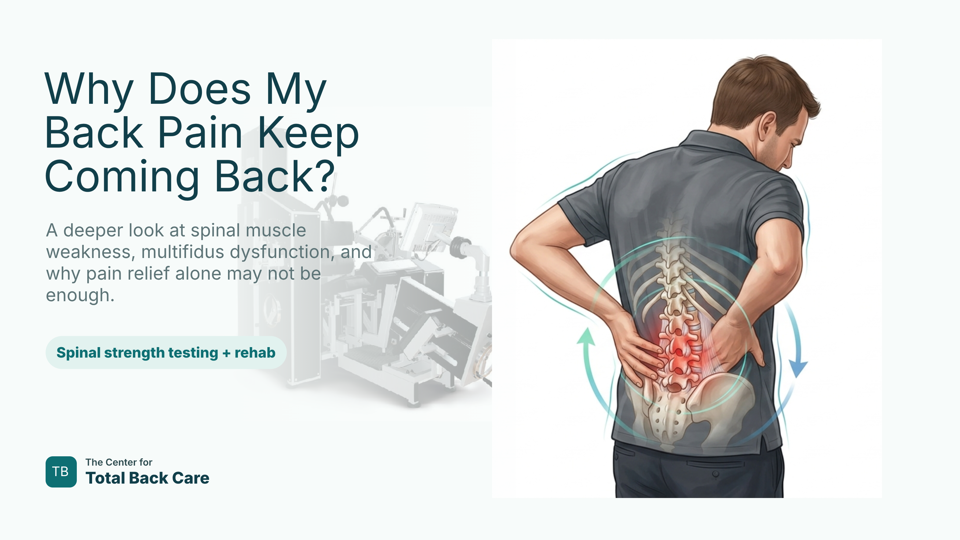
Why Does My Back Pain Keep Coming Back?
If you've ever thought, "My back finally felt better, but now it's hurting again," you're not alone.
Many people experience a frustrating cycle where their back pain improves, only to return weeks or months later. While temporary relief is important, the bigger question is: Why does the pain keep coming back?
The answer is often that the underlying cause was never fully identified or corrected.
At The Center for Total Back Care, one of the most common things we see is patients treating the symptoms of back pain without addressing the factors that made their spine vulnerable in the first place.
Common Causes of Recurrent Back Pain
Back pain can return for many different reasons, including:
- Poor posture and prolonged sitting
- Repetitive bending, lifting, and twisting
- Previous injuries that never fully healed
- Disc injuries or degeneration
- Joint dysfunction
- Arthritis and spinal stenosis
- Reduced flexibility and mobility
- Weakness of the muscles that support the spine
- Physical deconditioning
While many people focus on discs, joints, or arthritis, one often-overlooked contributor is spinal weakness.
What Does Spinal Weakness Mean?
Your spine depends on a complex system of muscles to maintain stability during everyday activities.
These muscles help support the spine when you:
- Sit
- Stand
- Walk
- Lift
- Exercise
- Perform daily activities
When these muscles become weak, they may no longer provide adequate support. As a result, everyday activities can place more stress on spinal joints, discs, ligaments, and nerves.
Over time, this can lead to recurring episodes of pain, stiffness, muscle spasms, and reinjury.
Think of it this way:
If you repeatedly sprain your ankle because the supporting muscles are weak, the solution is not simply to wait for the pain to go away. You must rebuild strength and stability.
The same principle applies to your spine.
The Overlooked Role of the Multifidus Muscle
One of the most important muscles for spinal stability is the multifidus.
The multifidus is a deep spinal stabilizing muscle that runs along the vertebrae and helps control movement between individual spinal segments.
Research has shown that after an episode of back pain, the multifidus can become inhibited and weakened. In some cases, it may even begin to shrink and develop fatty infiltration.
This process is known as multifidus dysfunction.
When the multifidus is not functioning properly:
- Spinal stability decreases
- Abnormal movement patterns develop
- Other muscles compensate
- Stress on discs and joints increases
- The likelihood of recurrent pain rises
Unfortunately, these muscles are difficult to evaluate through a standard examination alone.
Many patients are told they are "fine" because imaging looks relatively normal or because their symptoms have temporarily improved. However, the underlying weakness may still be present.
Why Standard Testing Often Misses the Problem
Most healthcare providers can evaluate flexibility, posture, and basic strength.
However, accurately measuring the strength and endurance of the muscles that support the spine requires specialized equipment.
This is one reason why spinal weakness often goes undetected.
A person may feel better for a period of time, return to normal activities, and then experience another episode because the underlying weakness was never identified or corrected.
How MedX Spinal Strength Testing Helps
At The Center for Total Back Care, we use MedX spinal strength testing to objectively measure spinal strength and identify deficits that may contribute to recurrent episodes of back pain.
MedX testing is designed to isolate and evaluate the muscles responsible for stabilizing and supporting the spine.
The testing allows us to:
- Measure spinal strength objectively
- Identify specific areas of weakness
- Compare performance throughout the range of motion
- Track progress over time
- Develop targeted rehabilitation programs
Rather than guessing whether weakness exists, we can obtain measurable data that helps guide treatment decisions.
For many patients, this information provides valuable insight into why their pain keeps returning.
Is There a Simple Self-Test for Spinal Weakness?
There is no perfect self-test for multifidus dysfunction or spinal weakness.
However, several warning signs may suggest that weakness is contributing to your problem:
- Your back pain repeatedly returns after activity
- Standing for long periods causes fatigue
- You frequently experience muscle spasms
- Your back "goes out" several times per year
- You feel unstable when bending or lifting
- Your symptoms improve with rest but return with activity
- Exercise programs provide only temporary relief
These signs do not confirm spinal weakness, but they may indicate the need for further evaluation.
When Should You Be Concerned?
You should seek professional evaluation if:
- Back pain persists longer than a few weeks
- Pain repeatedly returns despite treatment
- Symptoms interfere with work or daily activities
- You experience leg pain, numbness, or weakness
- You have frequent episodes of your back "going out"
- Your ability to exercise continues to decline
The longer spinal weakness persists, the more difficult it can become to break the cycle of recurring pain.
Treatment Options for Recurrent Back Pain
Treatment depends on identifying the underlying cause.
Common treatment options may include:
Targeted Spinal Rehabilitation
Specific strengthening exercises designed to improve spinal stability and restore muscular function.
MedX Testing and Strengthening Programs
Objective testing can identify weakness and guide a customized rehabilitation plan.
Chiropractic Care
Restoring joint mobility can help improve movement patterns and reduce stress on irritated tissues.
Dry Needling
Can help reduce muscle trigger points and improve function in overactive or painful tight muscles.
Interferential Therapy
Can help reduce pain and improve comfort during the rehabilitation process.
Activity Modification
Learning how to move, lift, and exercise properly can reduce unnecessary stress on the spine.
How to Prevent Back Pain From Returning
Preventing recurrent back pain requires more than simply reducing symptoms.
Successful long-term management often includes:
- Maintaining spinal strength
- Staying physically active
- Improving flexibility and mobility
- Practicing proper lifting mechanics
- Addressing posture and ergonomics
- Following a structured exercise program
- Correcting underlying muscle weakness
The goal is not just pain relief.
The goal is creating a spine that is more resilient and less likely to become injured again.
The Bottom Line
If your back pain keeps coming back, there is usually a reason.
While discs, joints, arthritis, and injuries may play a role, one commonly overlooked factor is weakness of the deep spinal stabilizing muscles, particularly the multifidus.
Because these muscles are difficult to evaluate through a standard examination alone, important deficits may go undetected.
At The Center for Total Back Care, we use MedX spinal strength testing and rehabilitation to objectively evaluate spinal strength, identify areas of weakness, and develop individualized rehabilitation programs designed to address the root causes of recurring back pain.
If you're tired of treating the same episode over and over again, a comprehensive evaluation can help identify what's really driving the problem and what can be done to prevent it from returning.