

Why Does My Lower Back Hurt When I First Get Out of Bed?

Understanding Morning Back Pain, Stiffness, and What You Can Do About It
The Center for Total Back Care | Mesa, Arizona
You wake up in the morning, swing your legs over the side of the bed, and try to stand up. Suddenly, your lower back feels stiff, tight, or painful. You may find yourself standing slightly bent forward, taking a few careful steps before you can straighten up.
But after walking around for 10 or 15 minutes, something interesting happens. Your back begins to loosen up, the stiffness improves, and you start feeling more like yourself.
Why does your lower back hurt when you first get out of bed, but feel better once you start moving?
This is one of the more common complaints I hear from patients at The Center for Total Back Care in Mesa, Arizona.
After more than 40 years of treating patients with acute and chronic spinal conditions, I've learned that morning back pain can have several different causes. Sometimes it's related to your sleeping position or mattress. Other times, it may indicate an underlying problem involving your spinal discs, joints, muscles, or the stabilizing system that supports your spine.
The important thing is understanding why your back hurts in the morning rather than simply trying to make the pain go away.
Why Is Lower Back Pain Often Worse in the Morning?
Your spine is designed for movement. Throughout the day, your muscles, joints, ligaments, and spinal discs work together to support your body as you sit, stand, bend, walk, and lift.
When you sleep, however, your spine remains relatively inactive for several hours.
During this time, several changes occur.
Your joints move less. Without regular movement, the tissues surrounding your spinal joints may temporarily become stiffer.
Your muscles remain relatively inactive. Muscles that help stabilize your spine are not being challenged the same way they are during normal daily activities.
Your spinal discs rehydrate. Throughout the day, your discs lose some fluid as they support your body weight. During sleep, they absorb fluid and regain some of their height. This is a normal process, but it also changes the mechanical stresses on your spine when you first get up.
Your sleeping position may place prolonged stress on certain structures. Remaining in an uncomfortable position for several hours can contribute to muscle tension and morning discomfort.
These changes help explain why your back may feel different first thing in the morning.
However, morning stiffness that improves with movement does not automatically mean there is nothing wrong with your spine.
Let's look at some of the more common causes.
1. Degenerative Disc Changes and Morning Back Pain
Between each of the vertebrae in your spine is an intervertebral disc.
These discs help distribute forces, allow movement, and absorb some of the mechanical stresses placed on your spine.
Over time, discs can undergo degenerative changes. They may lose some of their ability to retain water, develop structural changes, or become less effective at distributing forces.
Disc degeneration is common as we age and does not always cause pain. In fact, many people have degenerative changes on MRI without experiencing any symptoms.
However, when a disc becomes a source of pain, the first movements of the morning may be uncomfortable.
You may notice:
- Pain when transitioning from lying down to sitting
- Difficulty bending forward to put on your shoes
- Stiffness when first standing
- Discomfort when sitting for prolonged periods
- Improvement after gentle walking or changing positions
In some patients, disc-related pain becomes more noticeable when they bend forward immediately after getting out of bed.
This is one reason I frequently recommend that patients avoid aggressive forward bending or heavy lifting immediately upon waking, particularly when those activities reproduce their symptoms.
The goal is not to avoid bending permanently. It's to allow your spine to begin moving comfortably before placing it under heavier loads.
2. Facet Joint Arthritis and Morning Stiffness
Your spine contains small joints called facet joints, located at the back of each vertebra.
These joints guide and control spinal movement while helping maintain stability.
Like other joints in your body, facet joints can develop arthritic changes.
When these joints become symptomatic, patients may experience stiffness or pain after remaining in one position for an extended period.
Common complaints include:
- Lower back stiffness after sleeping
- Pain when first standing upright
- Discomfort when leaning backward
- Pain when twisting or rotating
- Improvement after gentle movement
Some patients describe feeling as though their back needs to warm up before they can move normally.
Although these symptoms can be consistent with facet-related pain, they are not specific enough to confirm the diagnosis.
A careful examination is necessary to determine whether the facet joints, discs, muscles, or other structures may be contributing to the problem.
3. Weak or Dysfunctional Spinal Stabilizing Muscles
This is an area I believe deserves much more attention when evaluating patients with recurring lower back pain.
Your spine depends on more than bones, discs, and ligaments for stability.
It also relies on a sophisticated system of muscles that work together to control movement and support your spine.
One of the most important of these muscles is the lumbar multifidus.
What Is the Multifidus Muscle?
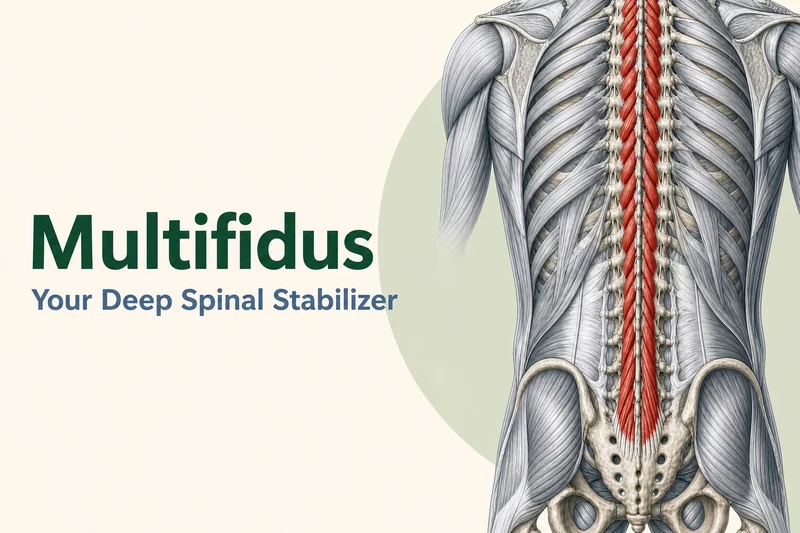
The multifidus is a deep spinal muscle that runs along the back of your vertebrae.
Unlike the larger muscles responsible for moving your trunk, the multifidus plays an important role in controlling small movements between individual spinal segments.
It helps:
- Stabilize the vertebrae during movement
- Control small movements between spinal segments
- Support the spine during bending and lifting
- Contribute to spinal stiffness and load management
- Coordinate with other muscles to maintain spinal stability
Following a lower back injury, the multifidus can experience changes in activation, strength, size, and muscle composition.
One possible mechanism is called arthrogenic muscle inhibition, or AMI.
This occurs when altered sensory information associated with joint injury or irritation interferes with normal muscle activation.
Think of it as a protective response that can sometimes outlast the original injury.
In some patients, the multifidus becomes less effective at performing its stabilizing function. Over time, reduced activity may contribute to muscle atrophy and fatty infiltration.
How Does This Relate to Morning Back Pain?
When you first get out of bed, your spinal stabilizing muscles must coordinate to support your body as you transition from lying down to standing.
If these muscles are weak, poorly conditioned, or not functioning efficiently, the movement may feel difficult or uncomfortable.
As you begin walking, muscle activity increases, and your movement may become more comfortable.
However, it is important to understand that multifidus dysfunction is only one possible contributor to recurring back pain. Morning stiffness alone does not establish that the multifidus is weak or inhibited.
Just because your back loosens up after moving doesn't necessarily mean the underlying problem has been corrected.
This is why evaluating spinal muscle function can be an important part of a comprehensive rehabilitation program.
4. Your Sleeping Position May Be Contributing to Your Pain
Sometimes the explanation for morning back pain is relatively straightforward.
Your sleeping position may be placing your spine under unnecessary mechanical stress.
For example, sleeping on your stomach can place your lower back in an extended position for several hours, particularly if your mattress allows your pelvis to sink.
For some people, this aggravates existing back pain.
Sleeping on your side without adequate support may also be uncomfortable if your hips and pelvis rotate excessively.
What Is the Best Sleeping Position for Lower Back Pain?
There is no single sleeping position that works best for everyone.
However, a few simple adjustments may help.
Sleeping on your back
Try placing a pillow underneath your knees. This may reduce tension through your lower back and make sleeping more comfortable.

Sleeping on your side
Place a pillow between your knees to help keep your pelvis and hips in a comfortable position.

Sleeping on your stomach
If this is your preferred position, a thin pillow under your pelvis may reduce excessive lower back extension.
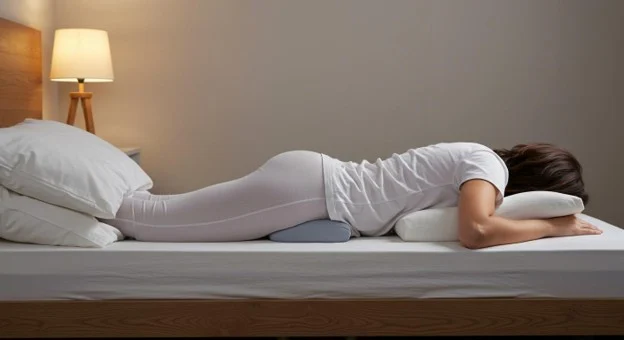
The best position is generally one that allows you to sleep comfortably without repeatedly aggravating your symptoms.
5. Your Mattress May Be Part of the Problem
Patients frequently ask whether they need a firmer mattress to relieve their lower back pain.
The answer is not always.
A mattress that is too soft may allow your hips and pelvis to sink excessively, placing your spine in an uncomfortable position. Always remember it is a lot easier to make a firm bed softer than a soft bed firmer!
On the other hand, a mattress that is too firm may create pressure points and make it difficult to find a comfortable sleeping position.
Research suggests that medium-firm mattresses may help some people with chronic nonspecific lower back pain, but individual preferences and body characteristics matter.
Before purchasing an expensive new mattress, consider whether your current mattress is sagging, worn out, or consistently associated with discomfort.
Also remember that a new mattress will not correct an underlying disc problem, significant muscle weakness, or another medical cause of back pain.
6. Inflammatory Conditions Can Also Cause Morning Back Pain
Not all morning back pain is mechanical.
Certain inflammatory conditions, including axial spondyloarthritis, can cause significant morning stiffness and pain.
Inflammatory back pain often has a different pattern than typical mechanical back pain.
Symptoms may include:
- Morning stiffness lasting more than 30 minutes
- Back pain that improves with exercise but not with rest
- Pain that wakes you during the second half of the night
- Alternating pain in the buttocks
- Symptoms that began gradually, often before age 45
These findings do not automatically mean you have an inflammatory spinal condition, but they should prompt further medical evaluation.
If your morning stiffness is prolonged or accompanied by other inflammatory symptoms, additional testing or referral may be appropriate.
Why Does My Back Feel Better After I Walk Around?
This is one of the most interesting aspects of morning lower back pain.
Many patients tell me that the first few minutes of the day are the worst.
They may struggle to stand upright or walk normally, yet 15 or 20 minutes later, their symptoms have improved significantly.
Why?
Gentle movement helps your body transition from several hours of inactivity into normal physical activity.
Walking increases muscle activity, moves the spinal joints through comfortable ranges, and may reduce the sensation of stiffness.
It can also help patients regain confidence in their movement.
But there is an important distinction.
Feeling better after moving does not necessarily mean the cause of your back pain has disappeared.
If you repeatedly wake up with lower back pain, the pattern deserves attention, particularly if it is becoming more frequent or interfering with your daily activities.
Five Things You Can Do to Reduce Morning Lower Back Pain
If your back hurts when you first get out of bed, there are several practical steps you can try.
These suggestions are intended for uncomplicated mechanical back pain. If you have a significant injury, progressive neurological symptoms, or another diagnosed spinal condition, your exercise program may need to be modified.
1. Change How You Get Out of Bed
One of the easiest ways to reduce discomfort is to avoid abruptly sitting straight up from a lying position.
Instead, try the log-roll technique.

- Roll onto your side.
- Bend your knees slightly.
- Allow your legs to move over the edge of the bed.
- Use your arms to push your upper body into a sitting position.
- Pause briefly before standing.
This technique can reduce uncomfortable twisting and bending during the transition.
2. Start With Gentle Movement
Before getting out of bed, try a few gentle movements to help your back become more comfortable.
For example, while lying on your back with your knees bent, slowly tilt your pelvis forward and backward through a comfortable range.
You can also gently move your knees a small distance from side to side if that feels comfortable.
Avoid forcing any movement or stretching into significant pain.
3. Walk for Five to Ten Minutes
Once you're out of bed, take a short, comfortable walk.
You don't need to walk quickly or cover a long distance.
The objective is simply to get your muscles working and your joints moving.
For many patients, gentle walking is one of the most effective ways to reduce the sensation of morning stiffness.
4. Improve Your Spinal Strength
This is where long-term rehabilitation becomes particularly important.
If your spinal muscles are weak or poorly conditioned, stretching alone may not be enough.
A comprehensive exercise program may include:
- Specific lumbar extensor strengthening
- Multifidus and spinal stabilization exercises
- Abdominal and hip strengthening
- Functional movement training
- Progressive resistance exercise
- Walking and general physical conditioning
The objective is to improve the strength, endurance, and movement control needed to support your spine during daily activities.
5. Avoid Heavy Lifting Immediately After Waking
If you consistently experience morning back pain, consider delaying strenuous lifting or repetitive bending until you've had an opportunity to move around.
This doesn't mean your spine is fragile or that bending is dangerous.
It simply means you may benefit from gradually increasing your activity rather than immediately placing heavy demands on an uncomfortable back.
Why Stretching Alone May Not Solve the Problem
One mistake I see patients make is assuming that every episode of lower back stiffness means they need more stretching.
Stretching can be helpful, particularly when reduced mobility or muscle tightness contributes to discomfort.
But not all back pain is caused by tight muscles.
If your symptoms are related to reduced spinal muscle strength, impaired movement control, or a disc or joint condition, stretching alone may provide only temporary relief.
Consider this example.
A patient wakes up with lower back stiffness every morning. After stretching and walking, the pain improves.
However, the same symptoms return the following morning.
The stretching may be helping manage the symptoms, but it may not be addressing all the factors contributing to the problem.
Flexibility is important, but so are strength, endurance, and spinal stability.
A complete rehabilitation program should address the specific deficits identified during examination rather than relying on one exercise or treatment for everyone.
How We Evaluate Recurring Morning Back Pain at The Center for Total Back Care
At The Center for Total Back Care in Mesa, Arizona, our approach begins with determining why you're experiencing pain.
Two patients may describe identical morning symptoms but have very different underlying problems.
One may have a disc-related condition.
Another may have painful facet joints, restricted mobility, or significant spinal muscle deconditioning.
A third may have symptoms requiring additional medical investigation.
That's why an accurate diagnosis is the most important first step.
Our Evaluation May Include:
A detailed patient history
We want to know when your pain occurs, how long the stiffness lasts, what makes it better or worse, and whether your symptoms extend into your legs.
A comprehensive spinal examination
We evaluate your movement, flexibility, neurological function when indicated, and other findings that may help identify the source of your symptoms.
Objective spinal strength testing
One of the technologies that distinguishes our rehabilitation approach is MedX spinal strength testing and rehabilitation.

MedX equipment allows us to assess lumbar extension strength under standardized testing conditions.
The specialized pelvic stabilization system is designed to limit pelvic movement and reduce the contribution of the hip extensors during lumbar extension exercise.
This allows us to place a more specific training demand on the lumbar extensor muscles.
It's important to recognize that MedX testing measures lumbar extension performance. It does not directly isolate or diagnose dysfunction of the multifidus muscle.
However, identifying deficits in spinal extension strength can help guide a progressive rehabilitation program.
Our Goal Is More Than Temporary Pain Relief
For patients with recurring lower back pain, reducing symptoms is important, but it may not be enough.
We also want to identify physical limitations that could be contributing to the problem.
Depending on the diagnosis, treatment may include chiropractic care, physiotherapy, targeted strengthening, MedX rehabilitation, or other appropriate conservative treatments.
The objective is to improve your ability to move, function, and tolerate the physical demands of everyday life.
When Should You Be Concerned About Morning Back Pain?
Occasional mild morning stiffness is common and does not necessarily indicate a serious spinal problem.
However, certain symptoms deserve further attention.
Schedule an evaluation if:
- Your morning pain occurs almost every day
- Your stiffness is becoming progressively worse
- Pain regularly interferes with getting dressed or walking
- Symptoms extend into your buttocks or legs
- You experience recurring episodes of lower back pain
- Your symptoms are not improving with reasonable self-care
- Morning stiffness lasts longer than 30 to 60 minutes, particularly with other inflammatory symptoms
Seek urgent medical attention if back pain is accompanied by new bladder or bowel dysfunction, numbness around the groin or saddle area, or rapidly progressive leg weakness.
Back pain accompanied by fever, significant trauma, unexplained weight loss, or a history of cancer also warrants prompt medical assessment.
Frequently Asked Questions About Morning Lower Back Pain
Is it normal for my lower back to hurt when I first wake up?
Mild occasional stiffness can occur after sleeping, particularly if you've remained in one position for several hours. However, persistent or worsening morning pain should not automatically be dismissed as normal aging.
Why does my lower back hurt in the morning but not during the day?
Several factors may contribute, including temporary joint stiffness, disc-related pain, sleeping position, and changes in muscle activity after prolonged rest. Movement may help reduce symptoms, but the exact cause requires evaluation.
Can a herniated disc cause morning back pain?
Yes. A symptomatic herniated disc can contribute to morning discomfort, particularly during bending, sitting, or getting out of bed. However, morning pain alone does not establish the presence of a herniated disc.
Is morning back pain a sign of arthritis?
It can be. Degenerative changes involving the spinal facet joints may contribute to morning stiffness. Certain inflammatory forms of arthritis can also produce prolonged morning pain and stiffness.
Should I stretch my lower back before getting out of bed?
Gentle movement may help, but aggressive stretching is not always appropriate. If bending or stretching increases your pain, stop and seek guidance about which movements are suitable for your condition.
Can weak back muscles cause morning stiffness?
Reduced strength and endurance of the spinal muscles may contribute to functional limitations and recurring back pain. However, weakness is not the only possible explanation for morning stiffness, and specific testing may help determine whether strengthening should be part of your rehabilitation.
What type of mattress is best for lower back pain?
A supportive medium-firm mattress may be helpful for some individuals with chronic lower back pain. The best choice depends on your comfort, body characteristics, sleeping position, and underlying condition.
How long should morning back stiffness last?
There is no universal normal duration. Brief stiffness that improves with movement is often less concerning than prolonged, severe, or worsening symptoms. Stiffness lasting more than 30 minutes, especially with night pain or other inflammatory features, deserves further evaluation.
Final Thoughts: Don't Ignore a Recurring Pattern of Morning Back Pain
If your lower back hurts when you first get out of bed but improves after you start moving, you're not alone.
This is a common complaint, and in many cases, conservative care and appropriate exercise can help.
But remember that morning back pain is a symptom, not a diagnosis.
The underlying cause may involve your spinal discs, facet joints, muscles, sleeping habits, or a combination of factors.
After more than four decades of treating spinal conditions, one principle continues to guide my approach:
The right diagnosis is the most important step toward the right treatment.
Rather than simply treating morning stiffness every day, I encourage patients to understand what is contributing to the problem and take steps to improve their long-term spinal health.
Tired of Waking Up With Lower Back Pain?
At The Center for Total Back Care in Mesa, Arizona, we help patients from Mesa, Chandler, Gilbert, Tempe, and surrounding communities identify the causes of their back pain and develop individualized treatment and rehabilitation programs.
If morning back pain is becoming a regular part of your day, it may be time to find out why.
Schedule Your Evaluation at totalback.com
Dr. B. Jeffrey Jolley, D.C., D.A.C.N.B. The Center for Total Back Care Mesa, Arizona