
The 3 Keys to Healthy Aging: Strength, Flexibility, and Weight
Aging Doesn’t Have to Mean Slowing Down
B. Jeffrey Jolley, D.C, D.A.C.N.B.
One of my longtime patients once told me that getting older had happened in “a series of tiny negotiations.” First he stopped carrying both grocery bags at once. Then he began choosing the chair with arms because it was easier to stand. He still played golf, but he rode instead of walked. None of those decisions felt important by itself. Together, they quietly made his world smaller.
I have treated patients with neck and back pain for more than 40 years, and I have seen this pattern many times. Most people do not wake up one morning suddenly weak, stiff, or deconditioned. Capacity usually fades by degrees. We adapt to each loss so smoothly that we may not recognize what is happening until a trip, a fall, a flare-up, or a demanding day reveals how much reserve we have lost.
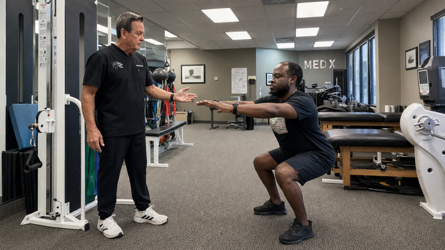
But I have also seen the opposite story. A patient begins with five careful chair stands. A few weeks later, stairs feel less intimidating. Someone who avoided bending learns to move with confidence again. A golfer rebuilds enough spinal endurance to finish a round without bracing for the drive home. These changes are rarely dramatic at first. They are the product of consistent, progressive work.
Growing older is inevitable. Becoming progressively weaker, stiffer, and less capable is not. Your genetics, medical history, injuries, and circumstances matter, but so do the choices and training signals you give your body today.
Three factors deserve special attention: strength, flexibility and mobility, and weight or body composition. They are not the whole of healthy aging—sleep, balance, aerobic fitness, nutrition, social connection, and medical care matter too—but they are three practical levers that affect nearly everything you want to keep doing.
THE BIG IDEA Healthy aging is less about chasing a perfect number and more about preserving physical capacity: the strength, movement, balance, and endurance to live life on your terms.
Key 1: Strength Is the Foundation of Independence
Muscle is not cosmetic tissue. It is active, adaptable tissue that helps you stand, carry, climb, stabilize joints, manage blood sugar, maintain bone health, and recover when life suddenly demands more from you.
Muscle mass and performance generally peak in early adulthood and then decline with age. The National Institute on Aging notes that the decline in muscle power and performance tends to accelerate later in life. This age-related loss of muscle, strength, and function is often described as sarcopenia. Inactivity, poor nutrition, illness, and long periods of pain can make the decline faster, but resistance exercise can slow it—and many older adults can still gain meaningful strength.
That matters because independence depends on reserve. Standing from a chair may use only part of your capacity when you are strong. As strength declines, the same task consumes more of what you have available. Eventually, a low seat, a heavy door, or a flight of stairs can feel like a maximum effort.
Strength also gives you options. When you stumble, you need fast muscular force to recover. When you travel, you may need to lift a bag, walk farther than expected, or rise from an unfamiliar seat. When illness interrupts your normal activity, a larger strength reserve can make the return to function easier.
Federal physical activity guidance recommends muscle-strengthening activity for all major muscle groups at least two days per week. “Strength training” does not have to mean bodybuilding. Depending on your starting point, it may include:
- Sit-to-stand repetitions from a sturdy chair
- Wall or counter push-ups
- Resistance-band rows
- Calf raises while holding a stable surface
- Step-ups on a low, secure step
- Free weights or well-adjusted exercise machines
- Carrying groceries, gardening, or other appropriately challenging tasks
The important ingredients are effort, control, and progression. A movement must challenge the muscle enough to stimulate adaptation, but it should remain technically sound and appropriate for your condition. Over time, you can progress by adding a few repetitions, slightly increasing resistance, improving range of motion, or performing an additional set.
PRACTICAL TEST Notice how you rise from a chair. Do you push heavily through your hands, rock forward several times, or avoid low seats? That does not diagnose a condition, but it is a useful reason to assess leg strength, balance, pain, and confidence.
Strength Is More Than Arms and Legs: Your Spine Needs Training Too
Most people understand the value of strong legs. Far fewer think about the muscles that control the neck and lower back.
Your spine is not held up by bones alone. Layers of muscle produce movement, maintain posture, manage load, and provide fine control between vertebral segments. Larger muscles create force and endurance. Smaller, deeper muscles—including the multifidus in the lumbar region—help coordinate precise segmental control.
After back pain, injury, surgery, or prolonged inactivity, this system can change. Pain may alter how muscles activate. People may brace, avoid movement, or rely on hips and larger trunk muscles to compensate. Even when pain settles, strength and endurance do not always return automatically. A person can feel better at rest yet remain underprepared for lifting, gardening, golf, prolonged sitting, or a busy travel day.
This helps explain why pain relief and rehabilitation are not always the same thing. Reducing symptoms is important. Rebuilding capacity is what helps the spine tolerate life again.
Our article on multifidus dysfunction and chronic low back pain explores how deep spinal muscle changes can contribute to persistent weakness. Another common barrier is fear: after a painful episode, people may understandably stop moving. If that sounds familiar, read Fear of Movement and Back Pain.
General exercise still matters. Walking, squatting, rowing, carrying, and whole-body strength training build valuable capacity. But when spinal weakness is suspected, a clinician may also need a way to isolate and measure the area more directly.
What MedX Spinal Testing Adds
At The Center for Total Back Care, we use MedX equipment for cervical and lumbar strength testing and progressive rehabilitation. The central idea is simple: measure instead of guess, stabilize to reduce compensation, and retest to document change.
During lumbar testing or exercise, the pelvis and lower body are stabilized so that the hips and legs contribute less to the movement. This matters because an ordinary “back extension” can easily become a hip-extension exercise dominated by the gluteal and hamstring muscles. Stabilization makes it possible to place a more specific multifidus activation and controlled demand on the lumbar extensors.
Cervical testing uses controlled positions through an appropriate range to assess neck-extension strength. The goal is not to force the neck through a range of motion or test pain tolerance. The goal is to gather objective information that can help guide resistance and track progress.
A typical clinical process may include:
Evaluation and safety screening. Symptoms, history, neurologic findings, medical conditions, surgical history, bone health, and current function help determine whether testing is appropriate.
Baseline measurement. Isometric strength can be measured at selected positions to create a strength profile.
Individualized loading. Exercise resistance and range are selected according to tolerance and clinical goals.
Controlled progression. Resistance changes gradually as strength and confidence improve.
Retesting. Objective comparison helps show whether capacity is changing—not merely whether someone had a good day.
Research on isolated lumbar-extension exercise is encouraging but should be prescribed carefully. Trials have reported improvements in lumbar strength, pain, and disability in some people with chronic nonspecific low back pain. A 2025 systematic review and meta-analysis examined randomized trials of isolated lumbar-extension training and found support for improvements in strength and clinical outcomes. Earlier controlled work also suggests that pelvic stabilization affects the specificity of lumbar training.
That does not mean MedX is a universal cure, that every patient responds the same way, or that a machine replaces a complete rehabilitation plan. Back and neck pain can involve discs, joints, nerves, sensitization, sleep, stress, workload, general conditioning, and other factors. MedX is best understood as a measurement and training tool within an individualized plan.
For a closer look at the service, visit MedX Spinal Testing and Rehabilitation.
WHY OBJECTIVE TESTING MATTERS Pain is real, but pain intensity does not tell us exactly how strong or enduring a muscle system is. Objective testing adds a different piece of information: what the spine can currently produce under controlled conditions.
Key 2: Flexibility Keeps Movement Available
Patients often tell me, “I’m just stiff because I’m getting older.” Age-related tissue changes are real, but inactivity, guarding, repetitive positions, and reduced movement variety may contribute just as much.
Flexibility refers to the range of motion available at a joint or group of joints. Mobility includes your ability to control movement through that range. You need both. Passive range without control is not automatically useful, and strength without adequate movement options can make daily tasks awkward.
Useful mobility lets you turn your head while driving, reach into a cabinet, get down to the floor, tie your shoes, take a comfortable stride, and rotate through a golf swing. The goal is not to perform extreme stretches. It is to maintain enough comfortable, controlled motion for the life you want.
Consistency usually matters more than duration. Five minutes most days may be more useful than one exhausting stretching session on the weekend. A sensible mobility practice includes:
- Warming up with a few minutes of easy walking or movement
- Moving slowly rather than bouncing
- Stretching to mild or moderate tension, not pain
- Breathing normally instead of holding your breath
- Choosing movements that leave you the same or better afterward
- Combining new range with light strength and control
If you want a starting routine for common lower-back stiffness, see What Stretches Help Back Pain? Try These 6 Gentle Moves. The article includes safety guidance because not every stretch is appropriate for every diagnosis.
Mobility is also connected to confidence. After pain, some people interpret every sensation as evidence of damage. Avoidance can then lead to more stiffness and deconditioning. Graded exposure—reintroducing safe movement in tolerable steps—can help rebuild trust in the body.
Balance belongs in this conversation too. Strength helps you create corrective force, mobility helps you access useful positions, and balance practice trains the nervous system to respond. Older adults benefit from multicomponent activity that includes aerobic exercise, strengthening, and balance.
Key 3: Weight Matters—But the Scale Is Not the Whole Story
Weight affects health, but it is often discussed too simply.
Excess body fat can increase cardiometabolic risk and may make walking, stairs, and exercise more demanding. Additional mass can also change the loads placed on the hips, knees, feet, and spine. If movement becomes uncomfortable, activity may decline, which can further reduce fitness and muscle.
But lower weight is not automatically better—especially later in life. A scale cannot distinguish muscle from fat, measure strength, or tell us whether someone is well nourished. Rapid dieting can reduce lean tissue along with body fat. Unintentional weight loss may be a warning sign, particularly when it appears with weakness, low appetite, fatigue, dental problems, trouble swallowing, or illness.
For healthy aging, the better question is not simply, “What should I weigh?” It is:
- Is my weight stable, rising, or falling over time?
- Am I maintaining muscle and strength?
- Can I perform the activities that matter to me?
- Am I eating enough protein and nutrient-dense food?
- Are sleep, stress, medications, or medical conditions affecting appetite or activity?
- Would changing body fat improve my health or mobility?
For some patients, gradual fat loss while preserving muscle may reduce health risk and make movement easier. For others, maintaining weight and rebuilding strength is the more urgent priority. That is why weight goals should be individualized rather than borrowed from a chart or social-media trend.
Sustainable weight management is rarely the product of a crash diet. It usually grows from repeatable behaviors: regular meals built around nutrient-dense foods, appropriate protein, walking and aerobic activity, resistance training, adequate sleep, and an environment that makes the healthier choice easier.
A BETTER SCORECARD THAN WEIGHT ALONE Track a small set of meaningful markers: waist trend, chair-stand ability, walking tolerance, strength progression, energy, sleep, blood pressure, and relevant laboratory values. The scale is one signal among many.
Why the Three Keys Work Better Together
Strength, mobility, and weight are not separate projects.
Stronger legs and spinal muscles can make walking, lifting, and daily activity easier. More movement increases energy expenditure and exposes joints to varied, useful motion. Improved mobility can make strength exercises more comfortable and technically efficient. Appropriate nutrition supports recovery and helps preserve muscle during weight change. A body weight that supports health can reduce the effort required for everyday tasks.
This creates either an upward or downward cycle.
In the downward cycle, pain or fatigue reduces activity. Strength falls. Ordinary movement becomes harder. Weight usually increases; or illness and poor appetite may cause harmful weight loss. Confidence shrinks, and the person does even less.
The upward cycle also begins small. A short walk makes the next walk more manageable. Two weekly strength sessions make stairs easier. Better sleep improves training and appetite regulation. Success restores confidence, and confidence encourages more activity.
Walking does not have to be monotonous. Some patients enjoy carefully progressing to different directions or surfaces. Our article on walking backward and back pain explains why backward walking can challenge coordination and the posterior chain, along with important safety considerations.
A Realistic Weekly Plan for Healthy Aging
The best plan is the one you can recover from and repeat. This sample week is a starting framework, not a prescription.
Two or three strength sessions
Train the major muscle groups with controlled exercises. Allow recovery between harder sessions. If spinal weakness or recurrent pain limits progress, seek an evaluation rather than repeatedly pushing through flare-ups.
Aerobic activity across the week
Adults should work toward 2-3 moderate-intensity aerobic activity per week when appropriate, but inactive adults can start with much less. Walking, cycling, swimming, dancing, and other rhythmic activities count.
Five to ten minutes of mobility most days
Choose a few areas that affect your daily function. Move after warming up, stay in a comfortable range, and avoid forcing pain.
Balance practice several times per week
Use a stable counter or qualified supervision when needed. Heel-to-toe stance, weight shifts, controlled marching, tstanding on one leg at a time and direction changes can be scaled to ability.
Recovery habits every day
Sleep, hydration, nutrition, medication management, and stress all influence how well you adapt.
A simple week might look like this:
- Monday: Full-body strength + short walk
- Tuesday: Brisk walk + mobility
- Wednesday: Balance practice + easy activity
- Thursday: Full-body strength + short walk
- Friday: Mobility + enjoyable aerobic activity
- Saturday: Longer comfortable activity with family or friends
- Sunday: Recovery, meal preparation, and planning
If that is far beyond your current routine, reduce it. Begin with five-minute walks and one set of a few exercises. Progress is built by matching the challenge to the person.
How to Start Safely
Most people benefit from moving more, but the starting point should reflect health status. Seek individualized guidance if you have recent surgery, frequent falls, unstable heart or lung symptoms, severe osteoporosis, progressive weakness, significant balance problems, or pain that consistently worsens with exercise.
Stop and seek prompt medical care for chest pain, fainting, severe shortness of breath, new bowel or bladder dysfunction, saddle numbness, rapidly progressive weakness, or sudden neurologic symptoms.
During ordinary training, use a simple response rule: the movement should feel controlled, symptoms should not spread or intensify, and you should recover as expected. Muscle effort and mild post-exercise soreness can be normal. Sharp, electric, or escalating pain is a reason to stop and reassess.
My Advice at 70
I am 70 years old, and I still make strength training a priority. I am not trying to compete with anyone. I train because I want to continue doing the work I value, helping my patients, traveling, and participating fully in my own active life.
The patients who age best are not always the people with perfect genetics or spotless medical histories. They are often the people who keep investing in capacity. They adapt when circumstances change. They ask for help when they need it. They keep moving, even if the movement looks different than it did twenty years ago.
Healthy aging is not about denying age. It is about preparing for it intelligently.
Choose one action today. Perform five chair stands. Walk for ten minutes. Schedule the evaluation you have postponed. Put two strength sessions on next week’s calendar. Small actions are votes for the future you want.
The best time to start is today.
Build a Body That Can Keep Up With Your Life
Healthy aging is not measured only by birthdays, body weight, or the absence of pain. It is reflected in what you can do: rise, reach, carry, walk, travel, recover, and participate.
Strength gives you reserve. Flexibility and mobility keep movement available. A healthy approach to weight supports joints, metabolic health, and function without sacrificing muscle. Spinal strength deserves a place in that plan because your neck and back support nearly every activity you perform.
If neck or back pain has made it difficult to stay active, The Center for Total Back Care can help identify the factors limiting you. MedX spinal strength testing may be appropriate when objective measurement and targeted cervical or lumbar rehabilitation are needed.
Call 480-633-8293 or book an appointment online to schedule an evaluation in Mesa, Arizona.
Sources
National Institute on Aging. How Can Strength Training Build Healthier Bodies as We Age?
National Institute on Aging. Three Types of Exercise Can Improve Your Health and Physical Ability
U.S. Department of Health and Human Services. Physical Activity Guidelines for Americans, 2nd edition
Steele J, et al. The effect of lumbar extension training with and without pelvic stabilization on lumbar strength and low back pain. *Journal of Back and Musculoskeletal Rehabilitation*. 2013.
Fisher J, et al. Isolated Lumbar Extension Resistance Training Improves Strength, Pain, and Disability. *Occupational Medicine*. 2017.
Clemente FM, et al. Impact of isolated lumbar extension strength training on reducing nonspecific low back pain, disability, and improving function: a systematic review and meta-analysis. 2025.
totalback.com|480-633-8293